

In the past two decades, one narrative has continued to resurface with increasing intensity: the claim that Himara is Greek land and that its population is entirely Greek.
It is a claim that moves beyond academic discussion. It appears in political discourse, in public symbolism, and even in high-profile visits—such as the recent appearance of the Greek Prime Minister in Himara and Saranda.
But like many narratives in the Balkans, this one did not appear overnight.
It was shaped—slowly, deliberately—by history.
To understand it, we must return to a time long before modern borders existed.
During the centuries of Ottoman rule, much of the Balkans was brought under imperial control. Yet in the mountainous regions of southern Albania—Himara, Kurveleshi, and Rrezomati—authority was never fully established. These communities resisted not only domination, but the very idea of external rule.
The inhabitants of these areas recognized leadership rooted in their own past, particularly the legacy of Gjergj Arianiti. Even when the Ottomans attempted to accommodate them by installing a figure tied to that lineage, resistance continued. As a result, these regions were granted a level of autonomy, preserving both their local structure and their identity.
Yet autonomy came with consequences.
Because these communities remained Christian, they were placed under the authority of the Orthodox Patriarchate. What began as an administrative arrangement gradually evolved into something more complex. In the Balkans, religion has rarely existed separately from identity. Over time, the Orthodox Church became not only a religious institution but also a cultural and national influence.
This shift would prove significant.
As noted by Eqrem bey Vlora, the merging of religious and national identity in the region often worked to the disadvantage of Albanians while strengthening Greek influence. It was not simply a matter of belief—it became a matter of belonging.
The late 18th and early 19th centuries brought another turning point.
Under Ali Pasha of Tepelena, conflicts with the Suliots—known for their fierce independence—captured the attention of Europe. Their resistance against Ottoman authority made them symbols of defiance, widely reported in European newspapers of the time.
But there was a problem.
At that moment in history, Albania had not yet emerged as a clearly defined national state. For many observers abroad, the identities of Balkan peoples were unclear. As a result, these fighters were often perceived as Greek, not Albanian.
What began as a misunderstanding soon became something more.
The emerging Greek state seized this perception and used it to support territorial narratives, presenting regions with Albanian populations as historically Greek. It was a strategic use of a moment when identities were still fluid and borders undefined.
As the Ottoman Empire declined, the Balkans entered a period of transformation. New states were formed, and borders were drawn—often without fully reflecting the realities on the ground.
For Albania, the outcome was particularly significant.
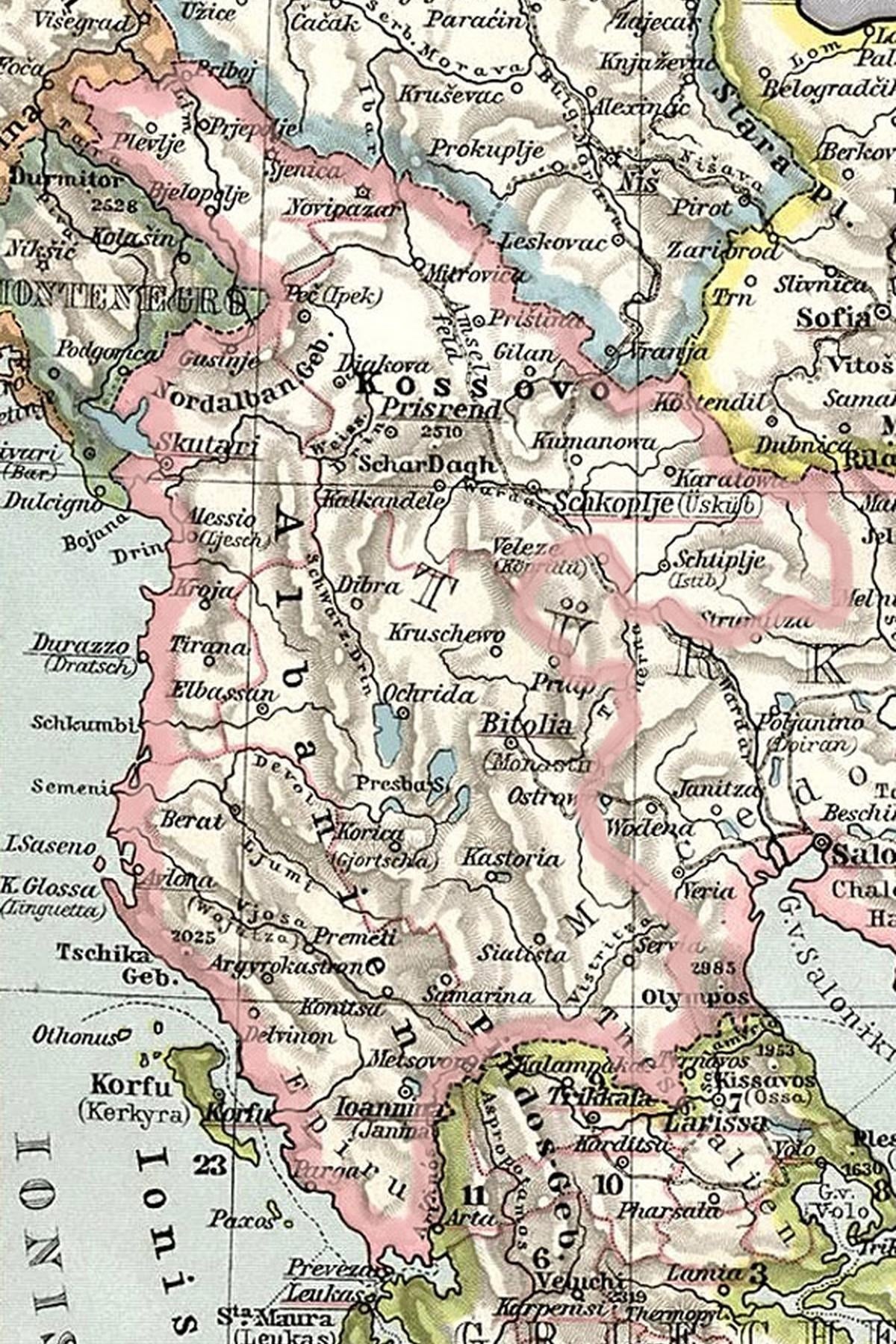
The Treaty of London in 1913 divided Albanian-inhabited lands, leaving large populations outside the country’s borders. This fragmentation has had lasting consequences, shaping both regional demographics and political narratives to this day.
In the decades that followed, history did not settle—it evolved.
After emerging from one of the harshest communist regimes in Europe, Albania entered a fragile transition period. Economic hardship, institutional weakness, and external pressures created an environment where competing narratives could take hold more easily.
In this context, claims about Himara have continued—not only as historical interpretations, but as part of broader political and strategic dynamics.
At the same time, many Albanians view these claims with skepticism, arguing that identity in regions like Himara is far more complex than it is often portrayed. Some go further, suggesting that external influence has played a role in shaping how identity is expressed and perceived in these areas.
What remains clear is this: the idea that Himara is inherently Greek is not the result of a single historical truth.
It is the product of centuries of shifting authority, the intertwining of religion and identity, misinterpretations by outsiders, and the strategic use of those misinterpretations during critical moments in Balkan history.
In regions like this, history is never static.
It is remembered, reshaped, and sometimes contested.
And to understand the present, one must first understand how these narratives were built.
Because in the Balkans, every claim has a past—and every past has a story.
